


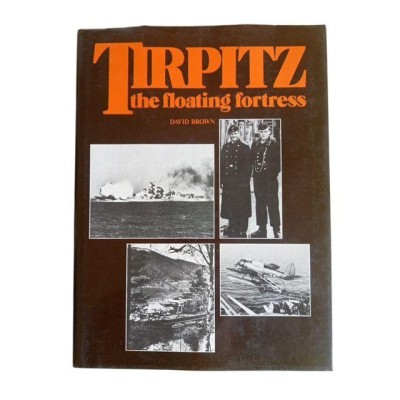

David Brown | Tirpitz the floating fortress
David Brown | Tirpitz the floating fortress | AAP (London),1977,1 vol. 18x25 cm, 160 p. ;,(amettre)
Relié, pleine toile noire et jaquette. Jaq. un peu défraichie. Nombreuses photos en noir. TBE. This is the story, in words and pictures, of the ‘lone wolf of the north’ – the largest battleship ever built for the German Navy. Launched in 1939 and commissioned in August 1940, the Bismarck was running sea trials in March of that year – two months before the spectacular sortie of Bismarck, her sister ship. Bismarck’s foray into the North Atlantic provided ample evidence of Tirpitz’s potential for destruction; it created a serious crisis for the Royal Navy while she was at large: not only did she sink a British capital ship, Hood, but she forced her opponents to mobilize a total of seven battleships, two aircraft carriers, and numerous cruisers and destroyers to hunt her down and sink her. In marked contrast to this, Tirpitz’s career was to be a negative one, essentially strategic, but nevertheless of considerable consequence. Lurking in a Norwegian fjord, Tirpitz posed a constant threat to the heavily defended Allied convoys that plied between Britain and the North Russian ports, and seriously limited the operational scope of the British Home Fleet. For nearly three years, she constrained the Royal Navy to allocate powerful forces to Arctic waters, plus an aircraft carrier that would have been much better employed in other theatres of the war. Attempts to winkle Tirpitz out of her lair were as unsuccessful, however, as the attacks made on her up to November 1944, when she was finally sunk. During this time, she was subjected to 13 attacks by a total of 600 British aircraft. And, in the end, the aircraft triumphed: on 12 November 1944, 29 Lancasters from Lossiemouth and Scotland inflicted such damage on the ‘floating battery’ that she capsized. The latent threat was finally eradicated. TIRPITZ the floating fortress is the full story of her design, construction and career. It includes five maps, a large fold-out drawing, a comprehensive text by Alan Raven, co-author of British Battleships of World War Two, and over 200 photographs, most of which have never been published before. (amettre)"
feedback Report comment